
DOT’s McGuinness Boulevard Plan in tug-o-war between those who like it and those who don’t

Ever notice how most roads don’t follow a straight path — or a consistent direction? There are doglegs and zigzags that move the compass needle as you go. Natural obstacles and property lines sway road design, as does safety: straight roads can be dangerous as they tend to enable “Highway Hypnosis” when the brain shuts down due to the lack of change or action that can keep it engaged, which can cause nodding off at the wheel.
Making my way west, on foot, along Greenpoint Avenue a few blocks from Monitor Street at around 8:50 a.m. on June 15, I realize my navigation was off. I should have kept on Norman Avenue and I would’ve reached 279 Monitor Street sooner. I was heading to the Keep McGuinness Moving Town Hall with DOT. This meeting was called by local businesses and residents who feel the NYC Department of Transportation’s (NYC DOT) plan for McGuinness will do more harm than good, hence they created an opportunity for the NYC DOT and local elected officials to listen to reasons from residents and businesses who oppose the road diet, ask for answers, and potentially sway the NYC DOT to adjust the plan.
As I took a photo of a poster for the town hall taped to a temporary wall, I heard a cyclist call out, “Join us at six tonight for the march: Bayard and McGuinness,” as he rode by on Greenpoint Avenue.
This would be the March on McGuinness organized by Make McGuinness Safe, an amalgam of community members and elected officials determined to make McGuinness safer after Matthew Jensen was killed crossing the boulevard in 2021. This march was supported by NYS Assembly Member Emily Gallagher and NYC Council Member Lincoln Restler.
About a block away from town hall I could hear chanting, “Let us in! Let us in!” from Make McGuinness Safe supporters. They held signs, each with a name of someone who was killed on McGuinness Boulevard.
A Moving Message
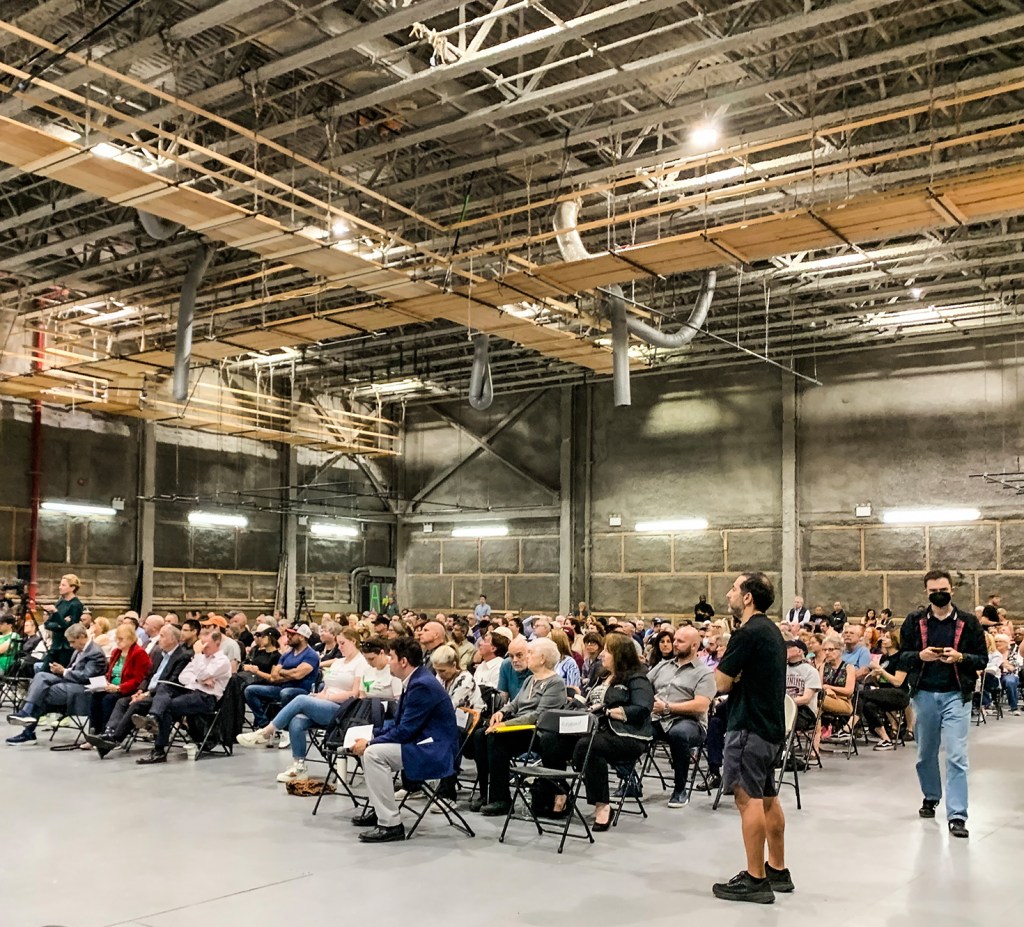
The Keep McGuinness Moving town hall was determined to keep the town hall a safe place for the opponents of NYC DOT’s road diet for McGuinness to voice their concerns. The group believes that outreach for the new design of McGuinness Boulevard did not reach a majority of local businesses and community members and their point of view is an important consideration in the design.
However, the NYC DOT web page https://nycdotprojects.info/project/1182/documents on the McGuinness Boulevard is and has been accessible to the public since the summer of 2021 and documents some of the outreach . The first workshop is dated August 4, 2021. A map of McGuinness that has been collecting public comments about the street also went up on the page on August 4, 2021; it is still collecting comments.
On the afternoon before the town hall, an email had gone out stating that due to “numerous instances of falsified registrations … we have been compelled to close the online registration process.” It also informed there was an onsite registration to accommodate those who wanted to come but missed the online registration window. A caution was included that bags larger than 12” x 6” x 12” would not be allowed into the facility. The town hall focused on presenting only Keep McGuinness Moving’s point of view.
The meeting began earlier than its scheduled time, though many were notified of this. NYC DOT Commissioner Ydanis Rodríguez opened the meeting and mentioned that no one knows the whole truth and that is why we should listen to each other. He also cautioned to keep the meeting respectful, if it got out of line it would end and would have to be taken up at another time. “If we don’t have the discipline to hear [a] person then we will not be productive.”
Some in the crowd asked that they wait to start the meeting at the appointed time, as more residents would be coming who had to drop off their children at school.

There was a pause and moments later NYC Council Member Lincoln Restler addressed the crowd, “What I’d like to ask is that we focus on the changes on McGuinness.” He requested they offer specific and actionable feedback for changes that will make the road better. “I’ve lived in this district my whole life; my number one concern is safety. We have experienced a serious crash on McGuinness Blvd every week, we’ve lost neighbors, we’ve suffered injuries: this is unacceptable. The deaths we have experienced on McGuinness Boulevard are preventable. We need to do what needs to be done to save lives. I believe we can make McGuinness safer. … We want to hear from you how we can make this plan better.”
NYS Assembly Member Rodneyse Bichotte Hermelyn (District 42) had been invited to speak, even though she mentioned her district is a distance away from McGuinness Boulevard. She is the chair of the subcommittee on oversight of Minority and Women-Owned Business Enterprises. She mentioned she was hit by a car as a child and bedridden so understands the need for road safety. In addition, she conveyed that she was sure there is a way to make McGuinness safer and keep business flowing.
Tony Argento founder of Broadway Stages, who provided the site for the town hall, mentioned safety should be a concern and the NYC DOT’s plan should be influenced by community and business input. He recalled when he came to this area in Greenpoint in 1996 there was only a dirt road with a lot of garbage and he helped clean the area up block by block to now, when there are thousands of jobs from the film industry, which also support other industries, “A lot of the people who work here spend their money at local businesses. … I also want to mention that I live here. … I am a part of this community.”
Dr. Eric Radezky, who previously was on former NYS Assembly Member Joseph Lentol’s staff for fourteen years, served as emcee. He mentioned he was an avid cyclist and a longtime resident of Morgan Avenue. He offered his belief that if McGuinness traffic is cut in half, that traffic would use the side streets. “That’s where I get concerned because it’s more dangerous for those of us who live on those side streets. … Basically, there are a lot of people in this room who have had no input in this plan. Who only learned about it recently. … That’s why we’re here today: to hear those opinions. To hear those questions that have not been asked yet.”
He laid out the format of the meeting: speakers were limited to three minutes and to keep comments civil (no arguing or yelling) “We’re all Greenpoint neighbors.” That there would be no disruptions and those who caused a disruption would be asked to leave. He added, “Nobody here is against public safety.” A burst of applause came from the crowd. “Nobody here wants to see anyone get hurt on McGuinness Blvd or anywhere in the Greenpoint community. People are here today because they have unanswered questions or questions that haven’t yet to be asked. They are legitimate questions.”
Many questions asked at this town hall echoed questions that had been asked at Brooklyn Community Board 1’s (BkCB1) Transportation Committee meeting held on May 4. “Why are you going by a 2021 study? 2021 is a pandemic year and not representative.” “Where are the 2023 numbers?” “How do you know the new plan will dispense of the 30% cut-through traffic?” “What about those going from neighborhood to neighborhood — is that considered cut-through traffic?” “Won’t stalled traffic caused by going to two lanes have a negative impact on air quality, with all the idling?” “Won’t traffic spill over to the side streets and cause its own hazard?”
Longtime community activist, Christine Holowacz, offered many of those points, “I don’t believe the 30% will go to the BQE or Long Island Expressway. It will go to the side streets. Air quality will be impacted. Asthma rates will go up.” She conveyed there are alternatives to make McGuinness safer, “No one has blood on their hands. Accidents always happen. Why don’t we make a law that cyclists have to wear a helmet?” She then addressed Restler and Andrew Epstein (representing NYS Assembly Member Emily Gallagher), “Can you listen to us and go back and make changes when you have a demonstration scheduled tonight?” referencing the March to Make McGuinness Safe. Then she commented on how this community has a history of working together, but McGuinness has had a polarizing effect, “I’m so disappointed that there are two different groups and we can’t get together. There’s not been a time when we couldn’t find a solution.” She ended by requesting that U.S. Representative Nydia Velázquez get involved.
Randy Peers of the Brooklyn Chamber of Commerce said, “Everyone has been affected by tragedy. This is not about that. I have nothing but love for the people sitting here or the people outside shouting us down.”

Randy Peers of the Brooklyn Chamber of Commerce speaks at the KMM town hall. Photo Credit: Lori Ann Doyon
The protestors could be heard from outside.
“All we are asking is for reengagement and to come up with a plan that is agreeable to everyone,” Peers concluded.
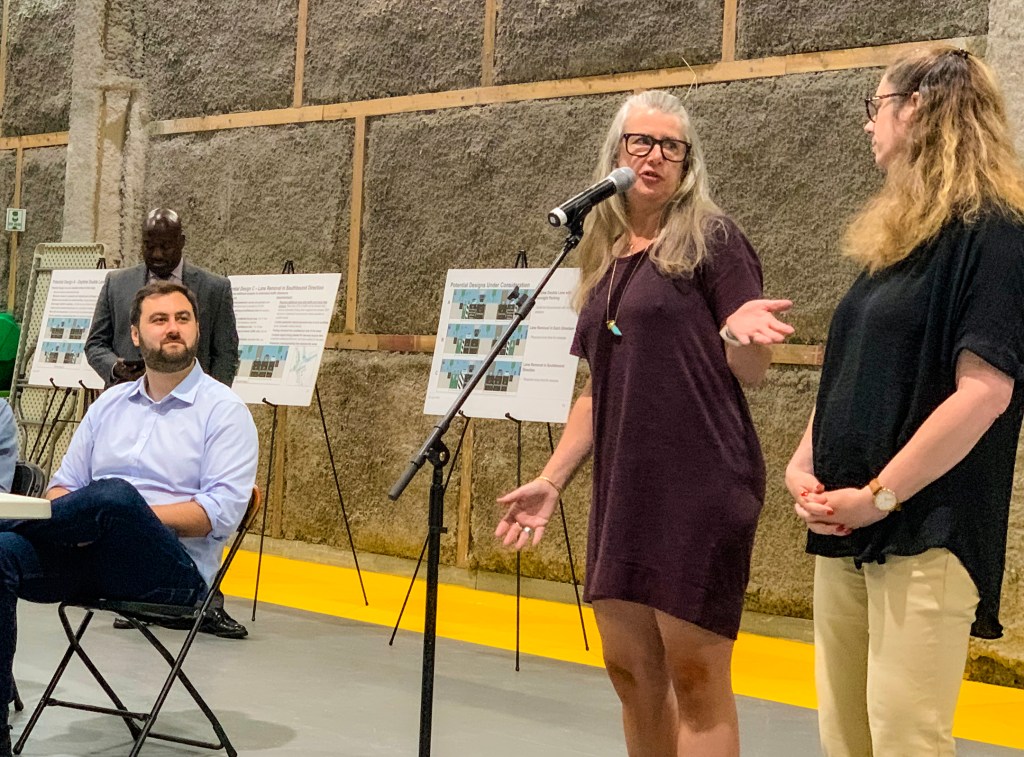
Leah Archibald and Karen Nieves of Evergreen, stated that safety is first and there is room for compromise if the two sides could work together.
“Now I feel everyone is so divided. We should work through this Let’s work together and look to the other options for the community as a whole. Let’s sit down and hear each other. Let’s get together and work together,” said Nieves
As the town hall was wrapping up, Keith Bray, Brooklyn borough commissioner of NYC DOT, said “Were listening to your concerns we want to work [with you]. This is a road diet that was proposed. We can have a discussion that’s why we are all here. I’m taking the feedback I heard today to address the plan.”
Later that same day at the March for Make McGuinness Safe
A large crowd assembled at Bayard and McGuinness at around 6 p.m. Without a headcount for either gathering it appeared that both crowds were equal in size.

This southern edge of McGuinness Boulevard is also the intersection where the P.S. 110 teacher, Mathew Jensen was killed by a hit-and-run. A multitude of all ages assembled, wielding signs that asked for safety and those from earlier that listed this street’s casualties. One held by a young girl announced, “4000 signatures”; this sign could be in reference to the Transportation Alternatives petition that at this writing has 5267 supporters.
Kevin LaCherra of Make McGuinness Safe welcomed the crowd and made a case that the NYC DOT’s plan was worked on with two-years of the community’s input to prevent McGuinness Boulevard’s dangerous history from continuing. He introduced NYC Council Member Lincoln Restler.
Restler said, “We are stronger together. As an elected official my job is to try to find common ground, to bridge different opinions and find the best solutions. But there is one thing, one thing that we cannot compromise on and that is our safety.” The crowd applauded. He stated McGuinness Boulevard’s weekly crash statistic he’d brought up at the morning’s town hall. “The status quo is literally killing us. We demand change. … The DOT and Mayor Adams have proposed a road diet here on McGuinness, which is the most comprehensive way to advance real safety in our community.” He stated U.S. Representative Nydia Velázquez, NYS Senator Julia Salazar, NYC Comptroller Brad Lander, NYC Public Advocate Jumaane Williams, and Brooklyn Borough President Antonio Reynoso support a road diet on McGuinness Boulevard.
NYS Senator Kristen Gonzalez revealed she knows full well what it’s like being near a dangerous road. She referenced growing up near Northern Boulevard, which she called “the avenue of death”, “We should not be teaching our children and the next generation that we aren’t safe on our streets. That it is dangerous to walk outside.”

Emily Gallagher, “I wanted people to know that this was their community and they could really dig their heels in and stay here and be a part of something. Because that is what I found here. I find in this fight all of these feelings coming back, and the thing that I’ve learned so far in politics is that it is easier to do nothing and placate everyone than to have a vision and to try to make something better happen for our community, for our city, for our state, or for the world.”

Bronwyn Breitner (of BkCB1’s Transportation Committee, whose son was a student of Matthew Jenson’s, and who lives a block from McGuinness Boulevard) shared her account of hearing of Mr. Jensen’s death and having to relay that information to her child. She went onto explain, “This is only a one-mile highway. What is that? Why do we need a one-mile highway to connect two highways? DOT and we know that we do not. They know that cars and trucks are flying through this neighborhood shortcutting from the BQE to the LIE, and the design of the street incentivizes that. It invites that. When we take away a lane of traffic this will disincentivize that.”
Throughout the above, a few who were against the DOT’s plan for McGuinness caused disruptions and were asked to leave. They complied within a minute or two.

The march started and moved north blocking off the two northbound lanes of traffic. I followed it until Nassau Avenue. Then I made my way to the Greenpoint Library to return some DVDs. When I reached the library, I saw the march was still going strong as it passed Leonard Street.
Can these two sides meet?
Currently it seems these points of view are traveling parallel to each other — not in agreement, not able to meet up.
Keep McGuinness Moving (KMM) is wary of change and prioritizes drivers, as a literal interpretation of its name conveys. “We demand the NYC DOT take the entire community’s opinion into consideration. I ask you strongly to preserve the traffic lanes that are currently present.” states the McGuinness Redesign Opposition Statement they are requesting the community to sign.
Make McGuinness Safe (MMS) prioritizes safety and wants change.
Many who have spoken out for KMM convey their long history in the neighborhood and how McGuinness Boulevard has worked for them. Many on this side do have safety concerns with McGuinness, but they counter that it is safe when people follow the rules. (A NYC DOT study contradicts this. It claims the most common pedestrian injuries occur when pedestrians are crossing with the signal.) They also want NYC DOT to give them traffic data on McGuinness that has been collected within the last two years and data on the safety measures that have already been implemented to see what effect they have had.
A Greenpoint resident on the KMM side mentioned another type of safety concern for the new design, “I live in a wood frame house. Our two firehouses combined make 8000 runs per year. How will McGuinness slow them down?”
An increase of traffic enforcement seems to dwell in a middle-ground of agreement. However, there are boundaries to this area of consensus.
In the comment section of June 26’s episode of the Brian Lehrer Show that featured a story the McGuinness Boulevard conflict, Laura Hofmann commented, “It’s been very upsetting to see the community being deliberately divided after so many years of activist work to bring opposing views together to get things done. The boulevard is indeed an unsafe place and we’ve known for years that enforcement was needed there. There’s been resistance on the elected and agency part to make that happen. But there’s dollars and large organization involvement here that’s driving a plan for one type of boulevard user over the other.”

The NYC DOT is considering the comments presented at the KMM town hall. At present there is no announcement of how this will affect its plans for McGuinness Boulevard. The streets are due to be painted sometime this summer.
Here is the NYC DOT page for the McGuinness Boulevard project, which contains all past presentations and most likely will be updated with any changes: https://nycdotprojects.info/project/1182/documents.

 The Greenline
One thought