
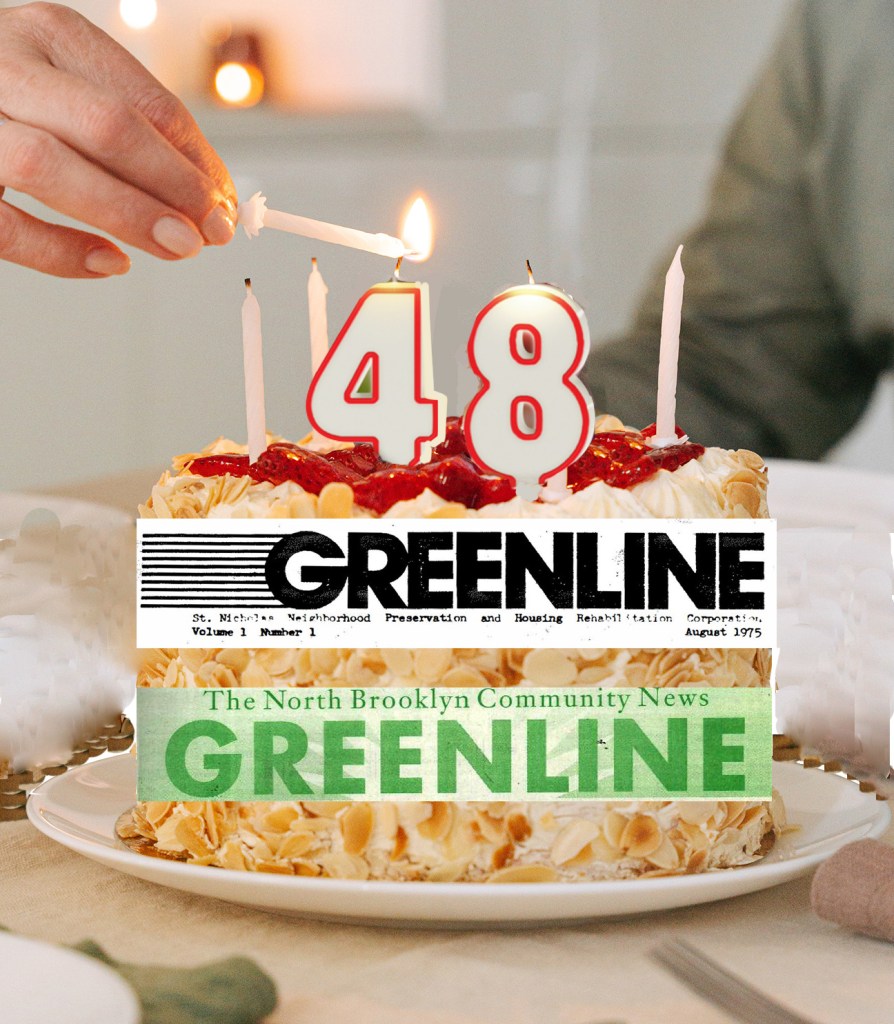
In August of 1975 the first issue of GREENLINE was published by St. Nicks Alliance. A while back I noticed the established date of 1974 was in error (and that would make the tally of years in error as well). No better time to correct things then in the anniversary issue.
Happy 48th Anniversary GREENLINE!
GREENLINE was named after “the strategy developed by the St. Nicks Alliance to combat the increasingly common problem of urban disinvestment or redlining,” stated a frontpage article of issue 1. The article went on to say, “[All components of the organization planned] to demonstrate to banks and other private institutions that this neighborhood is a much more vital and dynamic area than they give it credit for being.”
I wonder what those bankers are thinking now?
This first issue was six letter-sized pages stapled together. The paper’s masthead then is the same as it is today. There have been a couple redesigns of the masthead in the interim. One debuted in September 2000, this version then had a hue change in February 2006, until the original masthead returned in May 2015 and has since remained.
Articles in GREENLINE’s first year dealt with some of the same issues we have today.

In GREENLINE’s second issue, which was published in October, an article titled, “Let there be Light” by Gloria Olmo reported that local citizens had been hounding local government for nine years to get a traffic light on Metropolitan Avenue at Olive Street to make it safer. As nothing was being done, this group reached out to St. Nicks Alliance, who organized a meeting with local NYPD precincts, the NYC Mayor’s office, NYC Department of Transportation, and other local officials to coincide with a demonstration whereby protestors would block traffic in the intersection of Metropolitan and Olive until they received a traffic light there. “Once the people at the meeting realized that the community seriously intended to block traffic on Metropolitan Avenue until a traffic light was installed, an agreement was worked out between meeting participants,” stated the article.
And today we have a struggle for street safety on McGuinness Boulevard. The more things change, the more things stay the same.

 The Greenline