
When a human being considers going on a diet it’s usually because of health concerns, although sometimes vanity plays a role. Health as motivation may carry more sway, as there is a direr need coaxed on by the fear of reaching the end of one’s road sooner than necessary.
McGuinness Boulevard’s road diet was designed to improve the safety and health of the community. The final plan presented in May, cut out the fat by cutting out two lanes of traffic. Most who face a reality of cutting carbs, dairy, or sugar out of their diet are met with their own resistance, and denial, which can make some renege. Others realize change is the healthier choice.
On July 3, Mayor Eric Adams put the brakes on McGuinness Boulevard’s road diet. He had approved this plan in March. What changed?
As reported in a July 6 article in The City, a source claimed when Adams asked his chief advisor, Ingrid Lewis-Martin, for her thoughts on the matter she stated area businesses were against it and those who supported the plan were outside of the community.
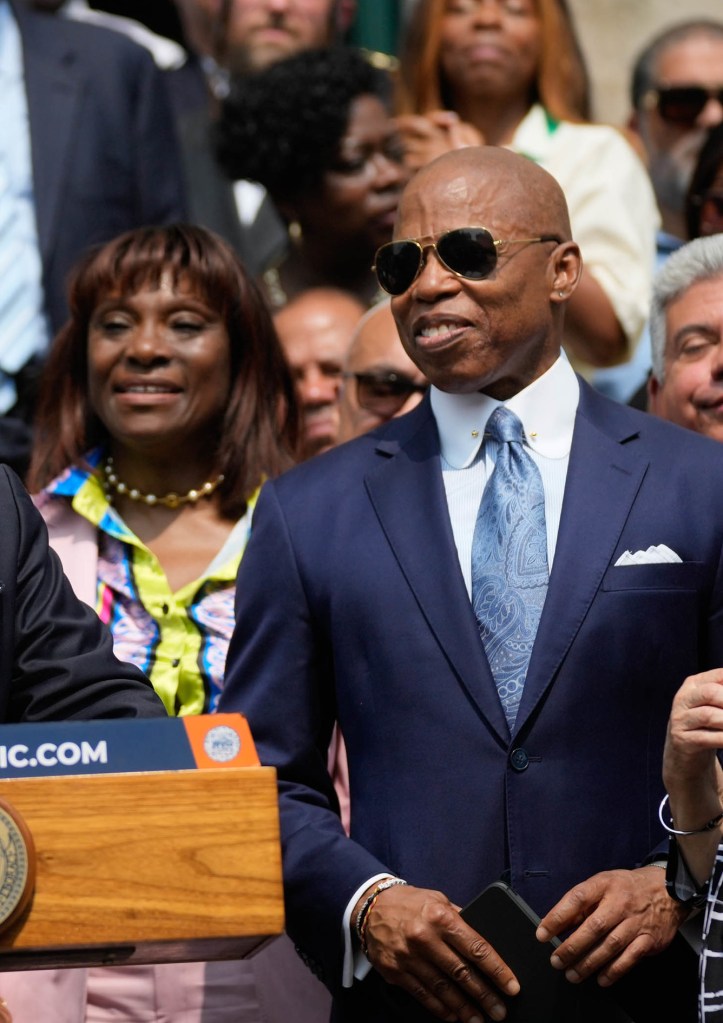
It was after the July 3 meeting concluded that the directive went out for a compromise to be developed on the McGuinness redesign plan.
During a July 10 press conference when Adams announced a law suit against four companies illegally selling disposable flavored e-cigarettes, he was asked about why he withdrew his support from the McGuinness Boulevard redesign.
“400 people had a meeting and they raised their concerns. And I listen to New Yorkers. I’m a biker, everyone knows that. I know the area; it’s in the nine-four precinct … I know it very well. I have been an advocate for safe streets. I have been an advocate for vehicle crashes [sic].”
That last bit could be interpreted by some as a Freudian slip, but it’s more likely he meant to say “against” instead of “for”.
Adams didn’t mention that hundreds of people marched on McGuinness Boulevard to support the NYC DOT’s plan the same day that 400-people meeting was held.
He claimed his advocacy for all who travel NYC streets is well known.
“I’m not going to force feed communities. My desire: we’d have protected bike lanes everywhere. But I’m going to respect the voices of the people [that] live in these communities. And we can find a win. It’s unfortunate that we are in a position now that everyone feels as though you must lose so I can win. And I just don’t believe that. … And if I decide within my role as the mayor that I want to reexamine, look at other ways of doing it, I’m going to do that.”
The reporter mentioned there was a petition signed by 7K community members that wanted the McGuinness road diet. Adams asked him, “Who’s the local councilman over there?” When he was told it was Lincoln Restler, Adams laughed and said, “Oh, okay” and then rolled his eyes and moved on to a different question.
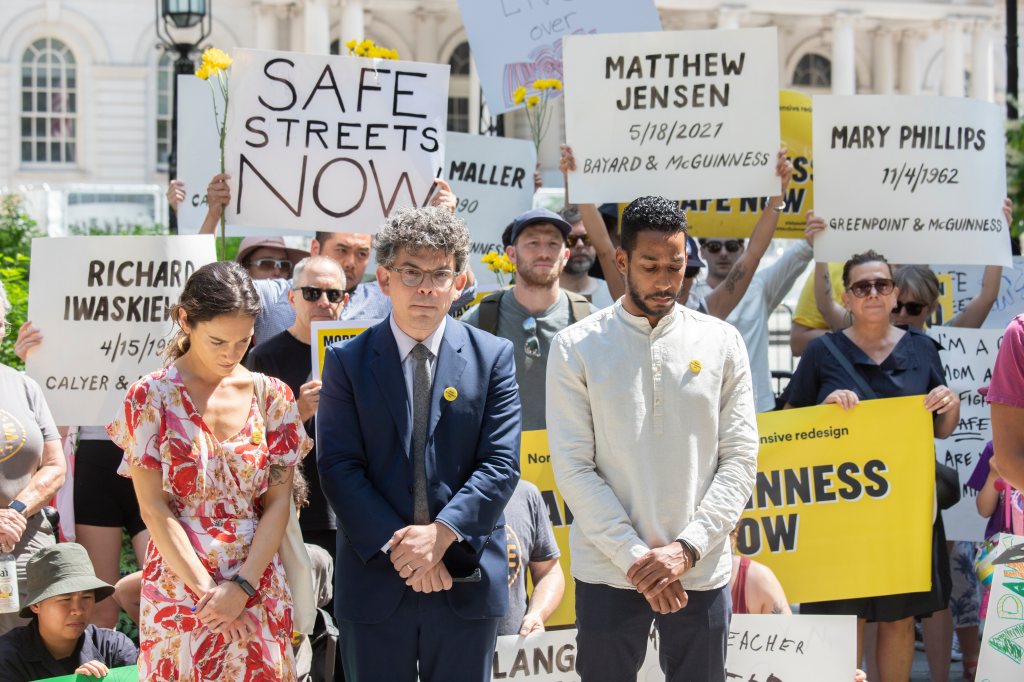
On July 13, Lincoln Restler brought receipts to a rally at City Hall with North Brooklyn community members and elected officials that called on Mayor Adams to return his support for the NYC DOT’s McGuinness Boulevard plan. He directly challenged Lewis-Martin’s claim that mostly outsiders supported this plan.
“7,000 neighbors signed on in support [of the plan to make McGuinness safer] 30% live within 1200 feet of McGuinness Boulevard. 2/3rds live in Greenpoint and Williamsburg, 96% of them are the residents of New York City,” said Restler.
On July 24, I reached out to the NYC DOT for an update.
I asked if the entire plan had come to a halt – or just the two-lane removal? If there was a timeline for next steps? Future plans for community outreach? If there was a possibility that any work would be done on McGuinness this year?
As to the last question, road paint needs to be applied before bad weather and the temperature gets too cold.
A NYC DOT Spokesperson replied, “NYC DOT is dedicated to enhancing the safety of critical arteries like McGuinness Boulevard. We’re reviewing community stakeholder feedback as we finalize the design,”
I also reached out to the NYPD to find out traffic enforcement statistics on McGuinness. They have yet to respond.
Whether you like the NYC Department of Transportation’s (NYC DOT) McGuinness plan or not, most agree it would make this dangerous road (with a crash occurring weekly) safer. However, all change has effect. Those against the road diet predict traffic would detour on side streets (making them more dangerous) and the removal of half the travel lanes would cause jams that would be bad for air quality.
This road redesign had been traveling down a path of community engagement since the second half of 2021, after a third person was killed on the street within ten years. On June 11, 2021, Mayor de Blasio committed $39M to redesign McGuinness Boulevard. In June 2022, The NYC DOT first presented three options for McGuinness Boulevard’s redesign to the community for its feedback. Later on the NYC Department of Transportation (NYC DOT) added this feedback to that from the subsequent community meetings and the project’s website to help develop the final choice, which was revealed at the May 4, 2023 Brooklyn Community Board 1 meeting.
Throughout, the process there were voices for the road diet and voices against the road diet.
Those who wanted a road diet had made their voices heard since Matthew Jensen was killed by a hit-and-run driver in May 2021 while crossing McGuinness. Their initial protests and advocacy received the support and funding from elected officials and pushed for change. They represented at meetings, engaged the community at events, gathered over 7K signatures on their petition to date.
Those who were against the plan made their voices heard at the community board meetings and comments on social media posts of advocates and elected officials that supported a safer McGuinness. In addition, Keep McGuinness Moving began their Instagram page on July 16, 2022 and published their website on September 29, 2022, which offered their mission statement, links to their petition, and NYC DOT presentations on the project. It wasn’t until June 15, 2023 that the site offered six safety implementations (from the U.S. Department of Transportation Federal Highway Administration) that could improve safety on McGuinness Boulevard. These suggestions are: appropriately timed yellow light change intervals, leading pedestrian intervals (gives a pedestrian a 3–7 second head start crossing before the light changes for drivers), speed safety cameras (captures photographic evidence of vehicles violating a set speed threshold), variable speeds limits (speed limit becomes dependent on traffic volume and road conditions), pedestrian hybrid beacon (a traffic control device designed to help pedestrians safely cross higher-speed roadways at midblock crossings and uncontrolled intersections), traffic signal backplates with reflective borders (to improve the visibility of the traffic signal). It was their hope that these could be tried first and if safety improved this would eliminate the need to remove two traffic lanes.
Keep McGuinness Moving also held a town hall, aka the 400-person meeting Mayor Adams mentioned, for those against the McGuinness road diet to speak out to the NYC DOT at one of Broadway Stages soundstages. They claimed there was little or no outreach to local businesses who would be financially harmed by the redesign. At the time they offered a petition with 180 signatures, however The City reported that multiple corporations represented on the list as single entities, could be traced to one entity, Broadway Stages. Later that same day, hundreds rallied and marched along McGuinness, as part of the Make McGuinness Safe coalition.
So far there is no agreement in the community as to how to make it safe and keep it moving.

 The Greenline
One thought