
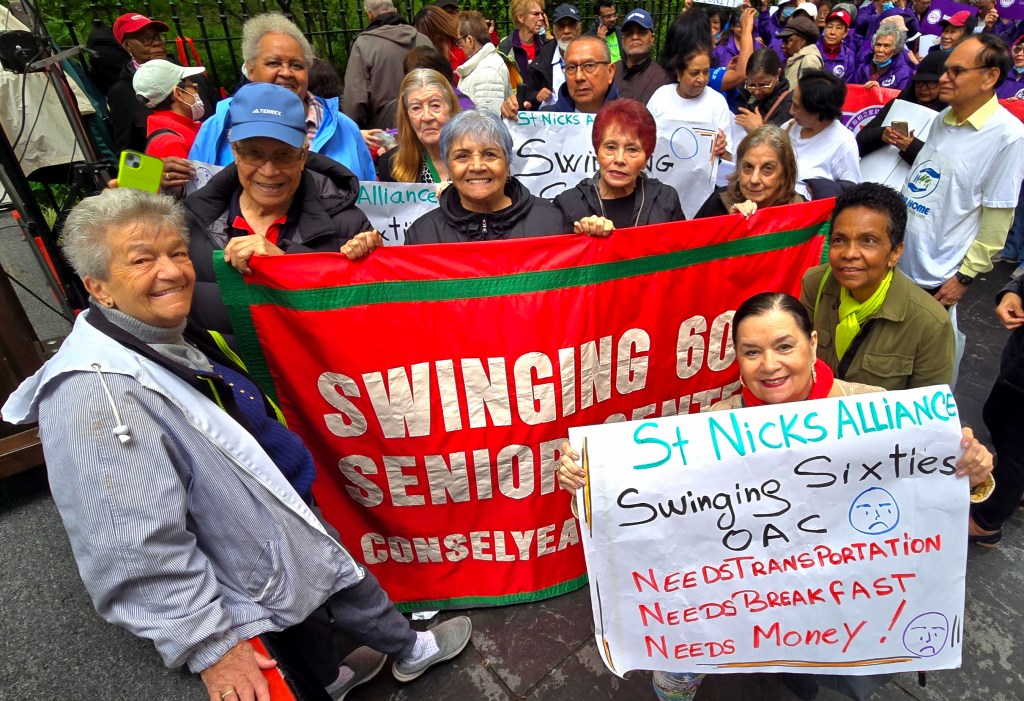
Community-based organizations and the city council are fighting for the NYC Department of Aging (NYC Aging) budget restoration amid Mayor Eric Adams’s proposed cuts. They are asking for even more investments as the population of adults over 60 continues to be the fastest-growing population in New York City.
Despite serving 1.8 million older adults, almost a fifth of the population, the department’s budget continues to account for less than half of one percent of the city’s overall budget. The proposed Fiscal Year 2025 budget is $27.8M less than the FY24 adopted budget and FY26’s budget will be $72.9M less than FY25’s. The decrease is partly because federal COVID-19 funds expire in FY25.
“There is no way that centers won’t close because of that deep of a cut,” said Cheryl Kamen, the deputy director of OACs & NORC at St. Nicks Alliance. In response to how these cuts will impact services at St. Nicks Alliance, she said, “We are past being cut to the bone; we are deep in the marrow.”
The NYC Council’s preliminary response to the budget called for the mayor to restore $78.2M to FY25. These funds are necessary for NYC Aging to make capital improvements at Older Adult Centers (OACs), fund home care and case management, and increase reimbursement rates for Home Delivered Meals (HDMs).
“Council is especially troubled in this case that the administration once again put precisely zero dollars in response to our proposals even though we identified over a billion dollars that the mayor’s preliminary budget left off the table that could keep key resources like our older adult centers open and fully operational while still ensuring us against economic hazards,” NYC Council Member of District 47, Justin Brannan, said at a budget hearing on May 17.
NYC Aging-funded services are facing many roadblocks, including OACs in need of repairs (five kitchens are closed), an average caseload of 1 to 58, with the largest being around 1 to 80, long waitlists for services (there are currently 776 clients on the case management waitlist and 322 on the home care waitlist), and reimbursement of food costs for HDMs are running at a deficit.
At the budget hearing, Lorraine Cortés-Vázquez, the commissioner of NYC Aging, addressed questions about these issues. She explained that the OAC repairs are not handled directly by them and encouraged borough presidents to follow the example of Brooklyn Borough President Antonio Reynoso, who gave $6 M for capital improvements for seventeen OACs across the borough. Average OAC usage is 81 percent, and NYC Aging plans to move resources to areas where utilization is high while closing OACs where utilization is low.
Additionally, Cortés-Vázquez said the department expects the need for home care always to increase and is advocating for state funding. However, the state has yet to give any funding. NYC Aging has spent $27M of its $39M home care budget for FY24.
The agency also said it cannot raise reimbursement rates for HDMs now. NYC Aging will review the cost per meal during the next quarter of the fiscal year to see if adjustments are needed. HDM reimbursements are running at a deficit of $2.53 per meal. The total number of contracts will decrease from 22 to 17.
“Ageism is pervasive in this year’s executive budget with a built-in hole of $80M that threatens to disconnect older New Yorkers from the services and support they need to stay involved in their communities,” said Kevin Kiprovski, the director of public policy at LiveOn NYC (which represents 110 service providers of NYC Aging).
LiveOn NYC and other organizations are requesting $50M for capital improvements, $20M for case management, $12M for HDMs, and additions to NYC Council’s discretionary funding, including $6.4M for Naturally Occurring Retirement Communities (NORCs).
Kamen said that without this funding, NORCs would be unable to hire the nurses the facilities require.
In June, NYC Council will vote on the FY25 adopted budget, that is to go into effect in July.

 The Greenline