

Inspired by other major city plans, like in London, Delhi, and others, Brooklyn Borough President Antonio Reynoso chose to initiate the creation of a comprehensive plan for Brooklyn.
“Comprehensive planning allows us to simultaneously respond to our most pressing challenges while creating a long-term, forward-looking vision that ensures New Yorkers today, and those yet to arrive, have the resources they need to access opportunity. Brooklyn is leading the way to bring comprehensive planning to New York City, and I am so proud to offer this resource to advocates and organizers fighting for a more equitable city,” said Reynoso. “It’s built on data, over a hundred maps, and the voices of Brooklynites themselves. Showing us where opportunity is missing, and how we can close those gaps.”
The 2025 Comprehensive Plan for Brooklyn is the creation of an Access to Opportunity Index. The tool weighs five major elements – education, transit, jobs and job resources, health and active living, and climate risk – to paint a picture of where opportunity is and is not in the borough. This visualization will help Reynoso, advocates, and community organizations identify areas in need of interventions, ensuring that investments in healthcare, economic development, and social services are directed where they are most needed.
As a NYC council member, Reynoso introduced legislation that would have created citywide comprehensive planning. In 2023, he took matters into his own hands by creating The 2023 Comprehensive Plan for Brooklyn which was then New York City’s largest borough-specific planning effort – surpassed only by The 2025 Plan.
As GREENLINE covers North Brooklyn, this article will highlight some of the findings for Williamsburg and Greenpoint neighborhoods, which the plan includes in the group of neighborhoods with the highest access to opportunity.
One unnerving statistic revealed by this plan is that South Williamsburg is among the Brooklyn neighborhoods, where the average lifespan is calculated at 75 years compared to the average lifespan of 81 years for all of Brooklyn. The plan identifies four indicators that affect health: access to medical care (access to health insurance and providers); individual behaviors (diet and drug use); social and demographic factors (poverty, racial disparities and how certain diseases affect communities differently, and social interactions); physical factors (built environment and access to food). According to the data, South Williamsburg residents have a higher percentage of residents reporting poor physical health and are among the Brooklyn neighborhoods that exhibit the highest levels of uninsured residents.
On a more positive note, Greenpoint and Willliamsburg are among the neighborhoods with the highest access to opportunity. Williamsburg ranks among the top neighborhoods based on high scores for job accessibility, transit connectivity, education, and proximity to healthy eating and active living amenities.
The Greenpoint-Williamsburg rezoning is addressed in the plan in several places. One insight given is that rezoning focused on either specific sectors such as tech, green economy, and entertainment, or specific neighborhood-level plans lacks an accompanying theory of land use: understanding what kinds of places various jobs and industries require to thrive and how they affect each other.
On the subject of housing, the plan states, “in 2024, Brooklyn outpaced all other boroughs in housing development: 40% of new housing completions and 42% of permitted housing in new buildings. Brooklyn increased production by nearly 4,500 units between 2023 and 2024.1 At the end of 2024, Brooklyn had more than 40,000 housing units in the pipeline (permitted units that are not yet complete), nearly double that of Queens. While Brooklyn is growing, that growth has not been equitably distributed across all neighborhoods, with much of that growth concentrated in Greenpoint, Downtown Brooklyn, Coney Island, Sunset Park, Gowanus, Brownsville, and Williamsburg.”
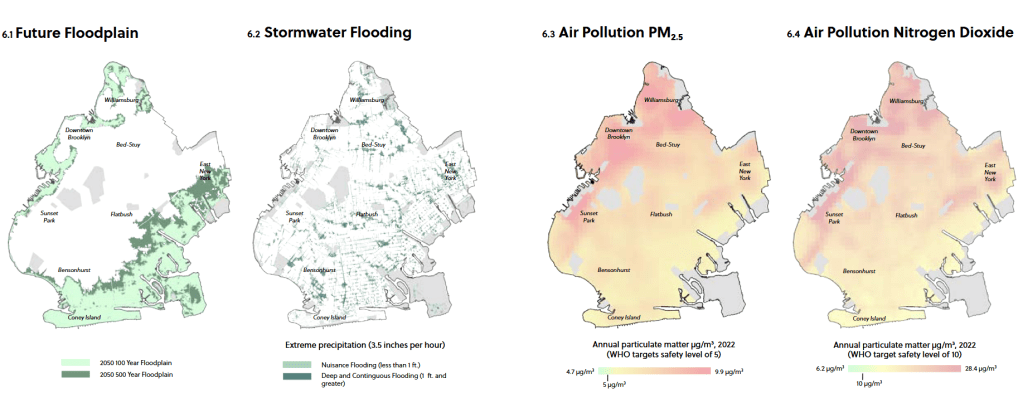
The need to improve air quality (indoor and outdoor) is a top concern for Williamsburg and Greenpoint. Both of these neighborhoods are among those with the worst annual pollutant levels according to recent NYS Department of Environmental Conservation (DEC) data. One major contributing factor to poor air quality is truck traffic.
An idea the blends improved air quality with transit is the BQGreen, which would cover the below-grade segment of the BQE in Williamsburg with a new park.
More transit ideas could bring The Independent Subway System’s (IND) ambitious “Second System” plan which proposed a subway line along Utica Avenue as part of a proposed line through Williamsburg, Bed-Stuy, and Manhattan. More recent proposals have evaluated an extension that branches off of the line that carries the 3 and 4 trains along Eastern Parkway. In addition, to upgrading all of the select bus service routes “to a full, physically separated bus rapid transit system would improve bus service for Brooklynites from Williamsburg to Sheepshead Bay, Bensonhurst to Canarsie, and Bed-Stuy to Marine Park.”
Data also shows that Williamsburg and Greenpoint are more youthful communities with the average age being younger than 37.9 years and with more college graduates.
This is just overview of a plan, that is worth more than a look.
Reynoso concludes his introduction to the plan, “We need to return to our roots as a city that thinks big and believes in the power of possibility and opportunity. The Comprehensive Plan does that. It contains both a visionary plan for the future and a set of policy proposals that are achievable right now. To get there, it’ll require political courage from elected officials and more of our neighbors standing up to organize for the change they want to see. Let’s get it done, Brooklyn.”

 The Greenline