
460 of its 1,150 units to become affordable housing

UPDATED on 12.19.2025
On November 12, area residents and advocates celebrated some happy news about Monitor Point, a proposed waterfront development at 40 Quay Street. The Gotham Organization (Gotham) revealed that they’ve committed to making 40% of the apartments affordable (460 units out of the 1,150 units) as the development moves closer to NYC’s formal review (ULURP) process. More than 40 were in attendance for this announcement, which was held at Southside United HDFC – Los Sures’s David Santiago Senior Center.
Tenant advocate organizations in attendance, United Neighbors Organization (UNO) and Los Sures’s La Lucha, have been working for greater affordability on the Williamsburg-Greenpoint waterfront, and Monitor Point sits on the largest remaining vacant property there.
Gotham and the Metropolitan Transportation Authority (MTA) joined forces to create a public-private partnership that aims to create a mixed-use waterfront community. This 40% affordability commitment from Gotham exceeds the 25% required under Mandatory Inclusionary Housing rules.
The proposal would make one of the development’s buildings, which would hold about 200 units, entirely affordable. Under New York City Department of Housing Preservation and Development (HPD) affordability standards, affordable rents in this building would be set to serve households that earn between 40% and 100% of the Area Median Income (AMI), with an average below 65% of the AMI.
A second building would be mixed-income, and would contain the remainder of the 460 affordable units. In this building, the affordable units will average 60% of the AMI alongside market-rate apartments. The cross-subsidy model enables deeper affordability through the market-rate units.
“We’re proud to deliver the largest investment in affordable housing on the North Brooklyn waterfront in a generation, while also creating new open space, safer streets and a more resilient waterfront for Greenpoint residents,” said Bryan Kelly, president of development at the Gotham Organization.
Neighbors support the development and share hopes for the future
“[UNO] members welcome Gotham’s proposal to develop Monitor Point and commit to 40% deep and inclusive affordable housing,” said Luz Rosario, president of UNO. “Our members have seen their family and friends pushed out of the neighborhood by high rents and are very dissatisfied with the low number of affordable units available so far in the waterfront. Gotham’s proposal offers the largest number of affordable housing units to be created by any developer on the waterfront so far, and it will be accessible to our families.”
“For decades, Los Sures has fought to keep longtime North Brooklyn families housed, healthy, and rooted in their community, and Monitor Point’s commitment to deep affordability moves that mission forward,” said Juan Ramos, executive director of Los Sures. “Creating new homes that working families can afford helps protect the cultural and economic diversity that defines our neighborhoods. We welcome projects like this that address the needs of community members.”
Frank Lang, the deputy executive director of housing at St. Nicks Alliance, said, “St. Nicks Alliance is excited that a waterfront project is committed to creating a substantial amount of apartments that will be affordable to the needs of low-income community residents. Monitor Point would have a higher percentage of on-site low-income homes than other recent developments. It creates an integrated complex that can welcome a diverse community of residents.”
Brooklyn Community Board 1’s most recent needs statement identifies affordable housing as the board’s most urgent priority. The rental vacancy rate in the area is just 2.3%, indicating a severe housing shortage.
The ULURP process
The Uniform Land Use Review Procedure – or ULURP – is New York City’s approval process for changes to how land is used, as required by the City Charter. The goal of ULURP is to provide a standardized and transparent review process for important land use decisions that incorporates public feedback. Not all development requires ULURP. However, when zoning changes apply development proposals must go through public review and approval.
Currently the ULURP process takes seven months. The first step is a public hearing via the community board that the development is in. Brooklyn Community Board 1 will hold a public hearing on Monitor Point on January 20, 2026, 6 p.m. at the Polish & Slavic Center (auditorium — 176 Java Street).
The Brooklyn Borough President will review next. Then the City Planning Commission holds a public hearing and if the commission approves, it goes to the NYC Council for a public hearing and their approval. If the NYC Council approves their decision is final unless the mayor vetoes it, when it would go back to the NYC Council for 2/3rds vote to override the veto.
On December 15, the NYC Planning Commission held a review session on the mapping of Monitor Point.
Environmental restoration and waterfront access
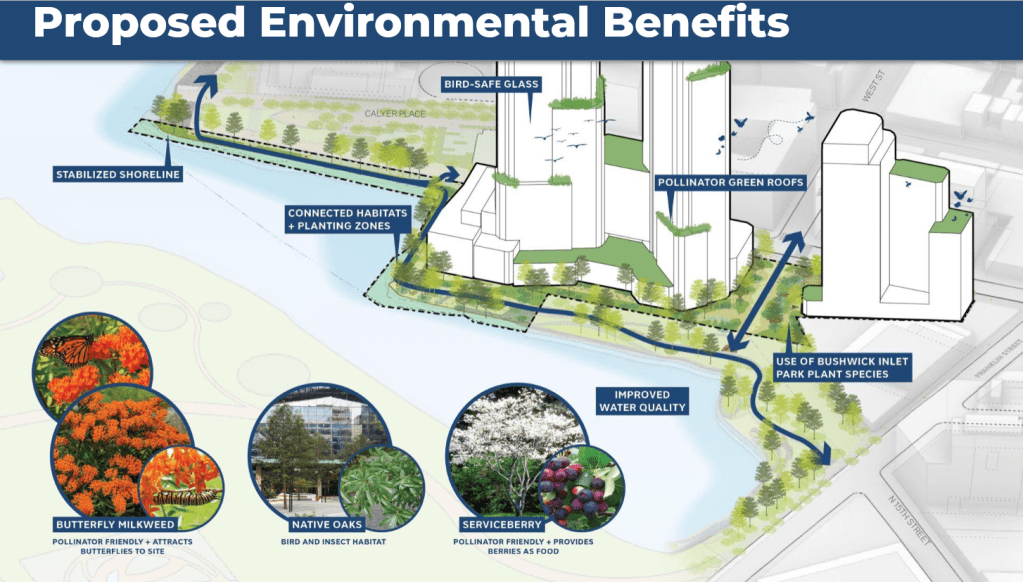
Gotham plans to benefit the environment in addition to housing element of the development.
The development plans to install new shoreline bulkheads and flood-resilient grading. Also they will replace invasive plants with native ones, which will improve habitat for birds and other wildlife along the waterfront.
They would connect their waterfront open space (around 50K square feet) to Bushwick Inlet Park, thus creating a continuous public waterfront.
However, supporters of Bushwick Inlet Park (called Save the Inlet) are currently advocating against the development due to worries about its environmental impact. Among the reasons they oppose the development are: the high-rise building is a threat to the natural habitat, it asks to remove the park designation on a parcel of the property, violates the 2005 rezoning agreement that stated the land would be a buffer and transition zone to protect the waterfront from overdevelopment. A petition that gives eight reasons to oppose Monitor Point has received 5,122 signatures as of 12.19.2025.
Museum and community investment
Since the early stages of planning Monitor Point, it was decided this development would provide a permanent home for the Greenpoint Monitor Museum. The development’s name was inspired by the USS Monitor, an ironclad warship built during the Civil War which launched from the location.
George J. Weinmann, co-founder of the Greenpoint Monitor Museum, said, “We’re proud to be a part of a project that finally creates a home where learning, community, and history all come together on the waterfront.”
In addition, the project also provides ongoing funding to the New York City Department of Parks & Recreation for maintenance of the adjacent Bushwick Inlet Park.

 The Greenline