
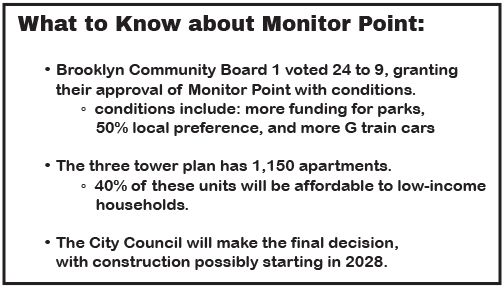
On Tuesday, Brooklyn Community Board 1 (BkCB1) voted 24-9, in favor of the Monitor Point proposal, a mixed-use development planned for Greenpoint’s waterfront. The development plan calls for three mixed-use buildings on an MTA-owned lot along the East River, as well as on other undeveloped land. The board vote included conditions, such as achieving 50% local preference for affordable housing, increasing the number of cars for the G train, and doubling funding for operating Bushwick Inlet Park. BkCB1’s full board vote voided a recommendation of its ULURP committee to reject proposals with conditions.
Monitor Point is the result of a public-private partnership between the Metropolitan Transportation Authority (MTA) and the Gotham Organization, which responded to an RFP to redevelop a mobile bus washing facility on the waterfront. The MTA required that any development relocate the facility, remediate the site, and provide access to the adjacent public park while developing a mixed-use residential project.
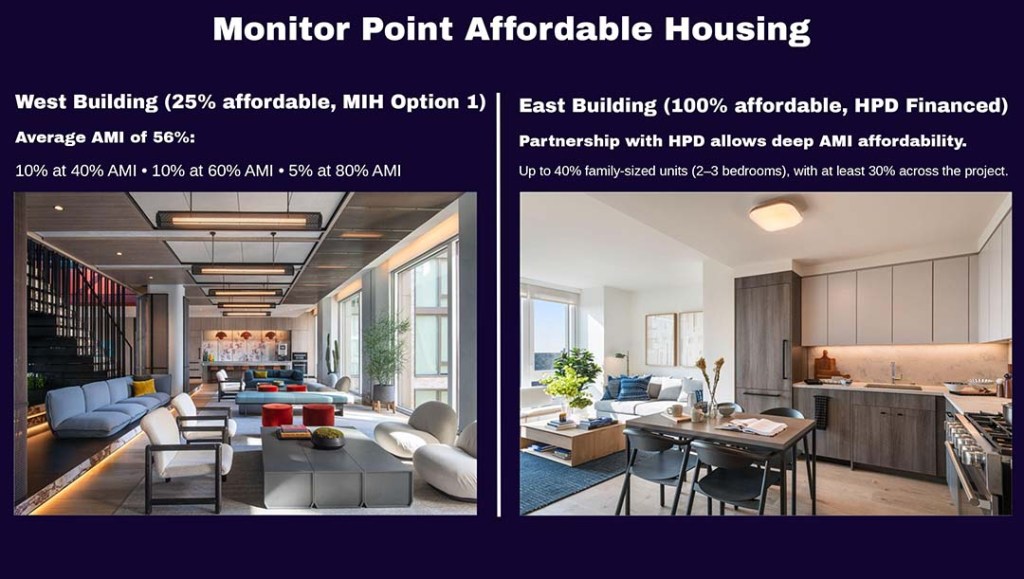
The Gotham Organization combined the MTA site with the adjacent property owned by the Monitor Museum to propose a rezoning enabling project that would include the museum, retail, and other community facility space, as well as a mix of market- and affordable-rate apartments. The rezoning would create 1,150 apartments, with 40% (460 units) as affordable. The developer commits to 40% affordable on-site, which breaks new ground in affordable housing development. Unlike other waterfront developments, Monitor Point, with the support of NYC Housing Preservation and Development (HPD), will offer affordable apartments targeted primarily to low-income households at 40%–80% AMI, rather than 130% AMI.
Many of the speakers at the BkCB1 public session cited the large number of apartments rented at levels targeted for low-income families as their reason for supporting Monitor Point. Many spoke about family members and friends being driven out of the neighborhood and unable to afford rents in the new projects, whose affordable units would be market-rate in many NYC neighborhoods.
Opponents of the project said the development is too large for the area, with towers up to 600 feet tall, and advocated for the site to become parkland.
“We all want more open space, but we must be honest: without safe and stable affordable housing, families like ours will no longer be able to afford to live in this neighborhood,”
stated Luz Rocero. “So the question becomes: parks for who? For wealthy newcomers and homeowners—or for long-time community members like us?”
The Gotham Organization noted that the cost to relocate the MTA facility to another site, build a modern facility, and remediate the site, along with all the environmental site work, including waterfront bulkhead and community facility components, requires a large-scale project and an increase in zoning. Many speakers applauded the number of low-income units and said the development would provide much-needed housing as the city grapples with a housing crisis.
“The affordable housing that Gotham is offering is going to be deeply affordable housing for a family making minimum wage to be able to afford,” said Rolando Guzman, deputy director of Community Preservation at St. Nicks Alliance. “We are talking about individuals who are making less than $45,000 a year, and we are talking about rent that is about $1,500, less than $2,000 a month — and that’s what the community really needs.”
The Monitor Point project will be reviewed by the board of the Brooklyn Borough President on March 11 from 6 p.m. to 8 p.m. at Borough Hall Courtroom, 209 Joralemon Street. Written testimony on Monitor Point can be submitted to testimony@brooklynbp.nyc.gov no later than Friday, March 13, 2026.
After that it goes before the NYC Planning Commission, which precedes the NYC City Council’s considers the BkCB1’s recommendation and ultimately decides whether to approve the project. If approved, construction is expected to begin in 2028 to be completed by 2031.

 The Greenline