
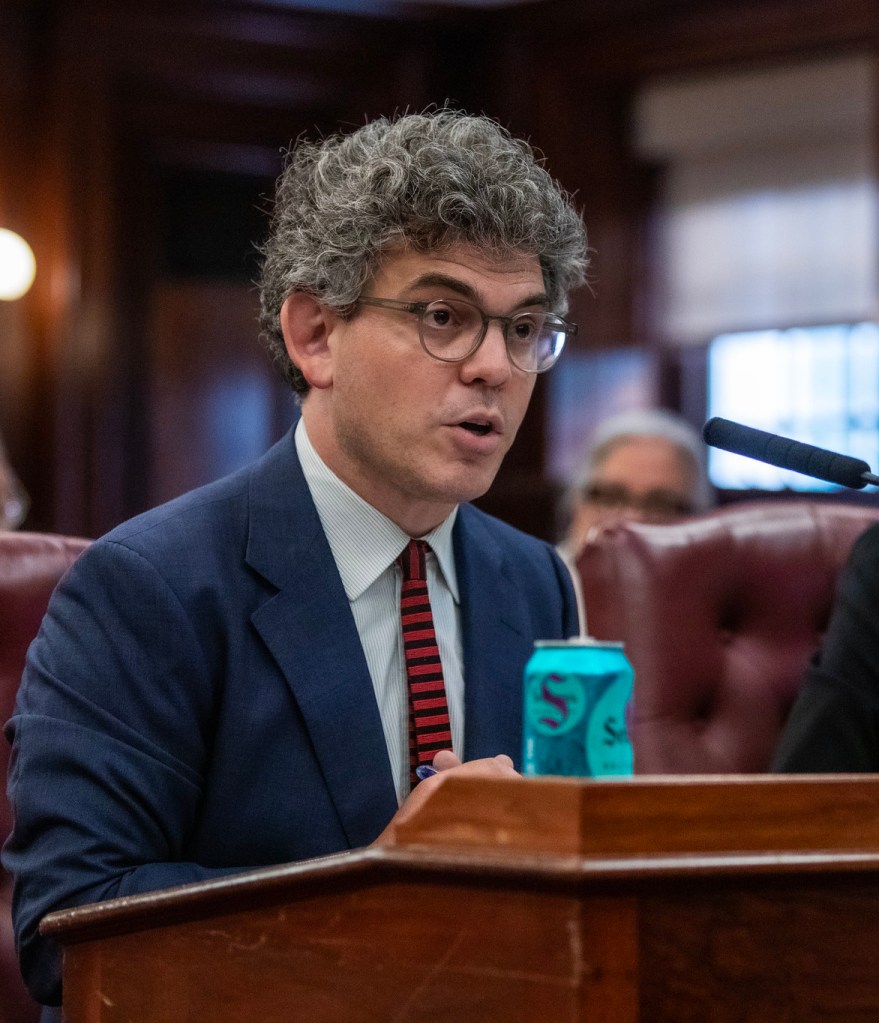
On July 16, the NYC City Council voted to approve the Monitor Point rezoning, which will yield 50% affordable units in the development, increased waterfront open space, and an enclosed space for the Monitor Museum. It took steady negotiation on NYC Council Member Lincoln Restler’s part to increase the affordable unit percentage at the site. As the proposed Monitor Point development is on public land he was adamant that any housing project built there would have to be at least 50% affordable.
“At my insistence this development will include 662 affordable apartments in this 13+ hundred-unit development. 50% of those units are going to be deeply affordable.”
NYC Council Member Lincoln Restler
NYC Council’s Subcommittee on Zoning and Franchises and Committee on Land Use voted to approve the Monitor Point rezoning at their meeting on June 25, within hours after 50% affordable units was achieved in addition to other changes added to the proposal.
This wasn’t the first time the development increased its affordable unit percentage. In January 2026, several North Brooklyn affordable housing advocates— including St. Nicks Alliance, and Southside United HFDC – Los Sures, and United Neighbors Organization — pressured Gotham, the developer of the Monitor Point project, to increase the affordable unit percentage from its original 25%. Gotham agreed to 40% affordable units.
40% affordability in such a development was unprecedentedly generous and maintained to be the limit for Monitor Point to be economically sustainable. However, members of the community and community leaders felt it was not enough. Their main argument was because it was on public land there should be at least an equity in how the public benefits from it. Equity is in question if the price of most of the units is outside the price range of most of the public. Restler led the charge to convince the developer to make the building at least 50% affordable, and he had some help along the Uniform Land Use Review Procedure (ULURP) way.
Monitor Point at 40% affordability went through the ULURP process and saw approval after approval, albeit with some conditions.
In February, Brooklyn Community Board 1 voted 24–9 in favor of the Monitor Point proposal. 50% local preference for the affordable units was one of their offered conditions.
On March 18, the Brooklyn Borough Board and Brooklyn Borough President Antonio Reynoso offered approval with multiple recommendations. The first recommendation was: maximize affordable housing across the site through every available and reasonable means. Increasing the overall percentage of affordable units to at least 50% of total units across the project was one of several suggestions that supported this recommendation.
These earlier recommendations supported Restler’s case in pursuing 50% or more affordability in the building.
Of the 662 affordable units: 329 will be deeply affordable units at 40% to 60% of the Area Median Income (AMI), 172 affordable moderate-income units at 80% to 125% of AMI, and 161 deeply affordable senior housing units at 30% to 50% of AMI.
At the June 25 committee meeting, Restler stated, “I am pleased today to express my support for the amended proposal for a majority affordable housing at the development known as Monitor Point at 40 Quay Street in Greenpoint.” He thanked the thousands of neighbors who reached out to him to share their perspective. “At my insistence this development will include 662 affordable apartments in this 13+ hundred-unit development. 50% of those units are going to be deeply affordable. To give you a sense: a family of three making $76,300 per year will be able to rent a two-bedroom at $1822 per month. That is deep affordability. 26% of the apartments will be for moderate-income households that’s a 172 units. 161 of the affordable homes will be designated for seniors, and we all know the need for affordable housing for seniors. That means a senior making $34,600 a year can rent a one-bed room for just $911. And 30% of the units, and this was very important to me personally, 110 apartments will be supportive housing. That’s deeply affordable housing for formerly homeless individuals with onsite services.”
Monitor Point aims to deliver 1,324 total units. 50% or 662 will be affordable and this will include: 329 deeply affordable units at 40% to 60% of the Area Median Income (AMI), 172 affordable moderate-income units at 80% to 125% of AMI, and 161 deeply affordable senior housing units at 30% to 50% of AMI. Approximately 110 (30%) of the affordable and senior units in one of the buildings in the project will be set aside for the formerly homeless.

Although this is a cause for celebration for housing advocates and mid- to low-income tenants, there are environmental concerns posed by park and greenspace advocates. They don’t see the infrastructure to sustain the building’s impact on the community.
Monitor Point borders on Bushwick Inlet Park, which is a parkland that supports various wildlife and contains a tidal estuary. Save the Inlet (STI), a group of dedicated individuals and supporting organizations, have been opposing overdevelopment on the waterfront, “as this overwhelms our natural spaces, public parks, and local infrastructure.”
The original height of the development is regarded to pose a danger to birds that migrate to and from the area. To obtain 50% overall affordability Monitor Point added units, which increased the height of its 100% affordable east building by fourteen stories. The heights of the three buildings are: 340 feet, 450 feet, and 600 feet.
A letter to NYC Council Member Restler from Katherine Conkling Thompson for STI states, “As we set out in our submission to the City Planning Commission, the original proposal was deeply flawed because it did not include open-space or infrastructure enhancements to account for the 2,795 additional residents the project would bring to the site. The Technical Memorandum reveals that the expanded proposal you negotiated will add yet another 449 residents, for a total of 3,244, yet likewise does so without any additional enhancements to account for them. Your approval is producing a project that will place enormous additional stress on the park, the surrounding sidewalks and streets, and the local transit system without the developer being asked to do anything to alleviate that stress.”
A recent New York Times article, “Housing or Flood Protection? In Brooklyn, Housing Is Winning,” published on July 13, raises the concern about the flooding that has been known to hit the Greenpoint area. Summer rains and winter snows can be arduous enough to navigate, and many recall what Sandy did to the community.
Gotham does address some of the environmental concerns by agreeing to contribute $300K annually to the long-term maintenance of Bushwick Inlet Park and expanding the waterfront public open space on the Monitor Point site to more than 52,500 square feet. There are also plans to lift the site and build a steel bulkhead (to mitigate flooding from the river). In addition, areas that had industrial roles will be remediated.
Monitor Point will also create a “brick and mortar” Monitor Museum. In its current conformation it’s a parcel of shoreline park that marks the launching of the U.S.S. Monitor in January of 1862. The Monitor was an ironclad warship that successfully engaged the C.S.S. Virginia in March of that year, yielding a Union victory.


